How long do you need to keep bank statements?
The record-keeping rule in 8 countries, from each tax authority's own guidance, checked on 2026-11-22.
In most countries, at least 5 years. Bank statements are supporting records for your tax return, so the period that matters is the one your tax authority sets, not how long your bank keeps them. 7 of the 8 authorities we checked require at least 5 years — the shortest is the US at 3 years in the ordinary case, the longest is New Zealand at 7.
The clock almost always starts when you file the return or when the tax year ends, not from the date printed on the statement. Below is each authority's own rule, with a link to the exact page, plus the cases where you must keep records for longer.
7 of 8
tax authorities require records kept at least 5 years
3–7 years
the range, from the US to New Zealand
5 years
median required record-keeping period
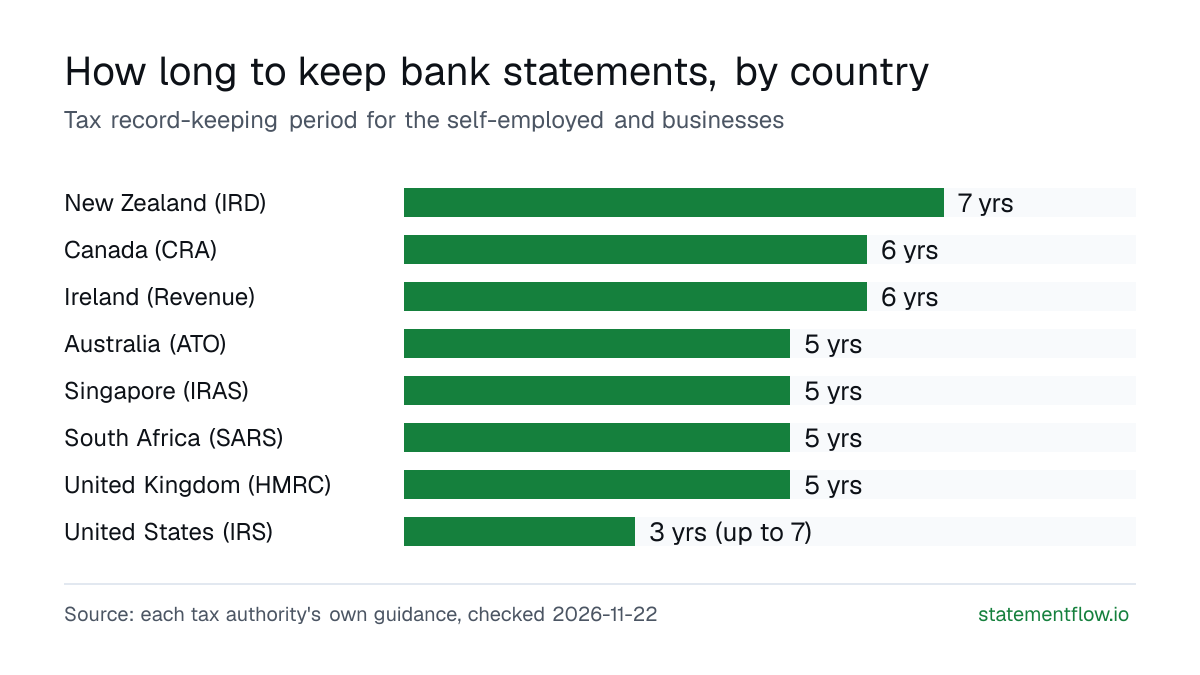
Embed this chart
Copy this HTML into your article. It includes the credit link.
<a href="https://statementflow.io/how-long-to-keep-bank-statements"><img src="https://statementflow.io/charts/how-long-to-keep-bank-statements.png" alt="Bar chart: how long to keep bank statements by country. New Zealand (IRD): 7 yrs; Canada (CRA): 6 yrs; Ireland (Revenue): 6 yrs; Australia (ATO): 5 yrs; Singapore (IRAS): 5 yrs; South Africa (SARS): 5 yrs; United Kingdom (HMRC): 5 yrs; United States (IRS): 3 yrs (up to 7). Source: each country's tax authority, checked 2026-11-22." width="1200" height="675" style="max-width:100%;height:auto"></a>
<p>Source: <a href="https://statementflow.io/how-long-to-keep-bank-statements">StatementFlow — How long to keep bank statements, by country</a></p>
The rule in each country
Download the CSV · Periods are for the self-employed or a business; individuals not in business sometimes keep records for less.
| Country | Authority | Keep records | Clock starts | Source |
|---|---|---|---|---|
| United States | IRS | 3 years (up to 7) | From the date you filed the return (or the due date, if later) | IRS |
| United Kingdom | HMRC | 5 years (self-employed) | From the 31 January Self Assessment deadline of the relevant tax year | HMRC (1)HMRC (2) |
| Canada | CRA | 6 years | From the end of the last tax year the records relate to | CRA |
| Australia | ATO | 5 years | From the date you lodge your tax return | ATO |
| New Zealand | IRD | 7 years | From the end of the financial year the records relate to | IRD |
| South Africa | SARS | 5 years | From the date you submit the return | SARS |
| Ireland | Revenue | 6 years | From the end of the year the transaction relates to | Revenue |
| Singapore | IRAS | 5 years | From the relevant Year of Assessment | IRAS (1)IRAS (2) |
The detail, and when you must keep records longer
United States — 3 years (up to 7)
Internal Revenue Service
Keep records for 3 years in the ordinary case. The IRS ties the period to its window to assess tax: 4 years for employment-tax records.
Keep longer: 6 years if you under-report income by more than 25%; 7 years for a claim from a bad debt or worthless securities; indefinitely if you file no return or a fraudulent one.
United Kingdom — 5 years (self-employed)
HM Revenue & Customs
If you are self-employed or in a partnership, keep records at least 5 years after the 31 January submission deadline. An individual who is not in business keeps records 22 months after the end of the tax year (15 months if the return was late). Companies keep records 6 years from the end of the accounting period.
Keep longer: Longer if you sent your return late, or if HMRC has opened a check into it — until that check is finished.
GOV.UK: how long to keep your records (individuals)GOV.UK: self-employed records
Canada — 6 years
Canada Revenue Agency
Keep all required records and supporting documents for 6 years from the end of the last tax year they relate to. If you file a return late, keep records 6 years from the date you file it.
Keep longer: Records tied to the long-term acquisition or disposal of property, the share registry, or a wind-up must be kept indefinitely.
Australia — 5 years
Australian Taxation Office
Keep your written evidence for 5 years from the date you lodge your tax return. Records must be in English (or readily translatable).
Keep longer: 5 years from your last depreciation claim for a depreciating asset; 5 years after a capital-gains event can no longer happen for a CGT asset; longer again if you are in a dispute with the ATO.
New Zealand — 7 years
Inland Revenue
Keep all your business records for 7 years after the end of the financial year they relate to, in English or Māori (offshore or cloud storage needs IRD approval).
Keep longer: Inland Revenue can extend the period to 10 years in specific cases.
South Africa — 5 years
South African Revenue Service
Keep records for 5 years from the date of submission of a return, in an orderly fashion and open to a SARS audit. Supporting documents such as bank statements fall under this rule.
Keep longer: If a required return is not submitted, records must be kept indefinitely until it is submitted, then for 5 years after. Records relevant to an audit or objection must be kept until it is concluded.
Ireland — 6 years
Office of the Revenue Commissioners
Generally keep records for 6 years, including bank and building society statements, under Section 886 of the Taxes Consolidation Act 1997. Failure to keep proper records for the required period is a Revenue offence.
Keep longer: Longer if Revenue has an open enquiry, audit or appeal — until it is settled.
Singapore — 5 years
Inland Revenue Authority of Singapore
Keep accounting records and source documents, including bank statements, for at least 5 years from the relevant Year of Assessment. For YA 2026 (income earned in 2025), that means keeping records until 31 December 2030.
IRAS: record-keeping requirements (companies)IRAS: keeping records (self-employed)
Keep the statement, in a format you can use
Because banks often remove online statements before your tax rule runs out (see how far back each bank lets you get statements), download your own copies while they are available and keep them for the full period. If you need the numbers, not just the PDF, convert them to Excel, CSV, QuickBooks or Xero. StatementFlow checks every line against the statement's running balance, so your archived copy reconciles.
Upload your statement
PDF, scan, or phone photo — any bank. Exports to Excel, CSV, QBO, OFX, or QIF.
Encrypted in transit · Processed in memory · Deleted immediately
Questions
How long should I keep bank statements?
Long enough to cover your country's tax record-keeping rule, because bank statements are supporting records. Of the 8 tax authorities we checked, 7 require at least 5 years: 3 years in the US in the ordinary case, 5 in the UK (self-employed), Australia, South Africa and Singapore, 6 in Canada and Ireland, and 7 in New Zealand. The clock usually starts when you file or when the tax year ends, not from the date on the statement.
How long do I need to keep bank statements for taxes?
It is the tax authority, not the bank, that sets this. The IRS keeps a 3-year assessment window in the ordinary case (6 years if you under-report income by more than 25%, longer for fraud). HMRC asks the self-employed for 5 years after the 31 January deadline. The CRA and Irish Revenue want 6 years, and New Zealand's IRD wants 7. Keep the statement itself, not just the summary.
Should I keep paper bank statements or are digital copies fine?
Digital copies are accepted by every authority in this table, as long as they are complete, legible and kept for the full period. The ATO requires records to be in English or readily translatable; New Zealand's IRD requires English or Māori and its approval to store records offshore. A PDF or a converted CSV/Excel file kept in your own records is fine.
Can I throw away bank statements once the tax period is over?
Only if no longer rule applies. The IRS says keep records indefinitely if you never filed or filed a fraudulent return; the CRA wants records about buying and selling property kept indefinitely; SARS wants them kept until an audit or objection is concluded. Outside those cases, you can dispose of records once the period has passed — but convert and back up anything you might need for a loan, visa or dispute first.
Is this how long the bank keeps my statements?
No — this is how long you are required to keep them. Banks often keep statements online for less time than the tax rule requires (some stop at 2 years of downloadable history), which is why you should download and save your own copies. See our companion dataset on how far back each bank lets you get statements.
How we checked
Every period comes from the tax authority's own guidance (10 source pages, linked in each row), checked on 2026-11-22. These are statutory record-keeping periods that cover bank statements as supporting records; they are not how long a bank keeps your statements. Periods differ by taxpayer type and by special cases, and rules change, so check the current guidance for your own situation. This is not tax advice.
Free to reuse with a link to this page (CC BY 4.0). Download the dataset as CSV.