Bank statement fraud statistics (2026)
14 statistics from 6 sources on bank statement and document fraud, each linked, compiled 2026-11-22.
Across lending, renting and account onboarding, fraud teams say the bank statement is the document most often faked — and generative AI is making convincing fakes cheap to produce. The figures below are drawn from fraud-detection, mortgage, rental and government sources; every one links to where it was published.
A note on us: StatementFlow converts bank statements and checks that their balances reconcile. It is not a fraud-detection service, and this page does not claim otherwise — it collects others' data because our users (bookkeepers, accountants, lenders) work with these documents daily.
Embed this chart
Copy this HTML into your article. It includes the credit link.
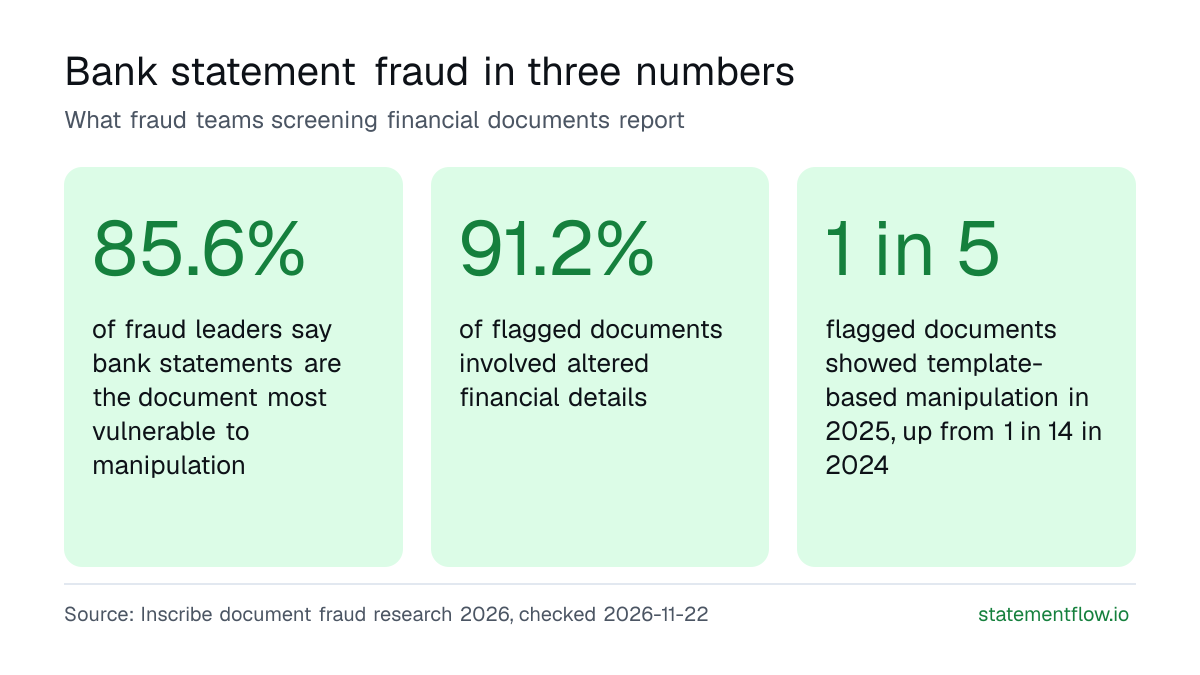
<a href="https://statementflow.io/bank-statement-fraud-statistics"><img src="https://statementflow.io/charts/bank-statement-fraud-statistics.png" alt="Bank statement fraud statistics: 85.6% of fraud leaders say bank statements are the document most vulnerable to manipulation; 91.2% of flagged documents involved altered financial details; 1 in 5 flagged documents showed template-based manipulation in 2025, up from 1 in 14 in 2024. Source: Inscribe, Document Fraud Statistics 2026 and 2026 Document Fraud Report." width="1200" height="675" style="max-width:100%;height:auto"></a>
<p>Source: <a href="https://statementflow.io/bank-statement-fraud-statistics">StatementFlow — Bank statement fraud in three numbers</a></p>
How often documents and bank statements are faked
Fraud teams that screen income and identity documents say bank statements are the document most often tampered with, and most tampering is to the financial figures themselves.
1 in 16
documents were flagged as fraudulent across Inscribe's network in 2025 — about 6% showed signs of manipulation.
Inscribe, Document Fraud Statistics 202685.6%
of fraud leaders named bank statements the document type most vulnerable to manipulation.
Inscribe, 2026 Document Fraud Report91.2%
of flagged documents involved altered financial details.
Inscribe, Document Fraud Statistics 20261 in 5
flagged documents showed template-based manipulation in 2025, up from 1 in 14 in 2024.
Inscribe, Document Fraud Statistics 2026Loans and mortgages
Lenders see forged income documents — edited pay stubs and bank statements that overstate reserves — as a leading fraud risk, and the measured rate is rising.
1 in 118
mortgage applications showed fraud indications in Q3 2025, up 8.2% year over year (1 in 26 for multi-unit properties, 1 in 45 for investment properties).
Cotality, via Inscribe60%+
of fraudulent personal-loan documents matched first-party fraud patterns (46% of fraudulent SMB-loan documents).
Inscribe, Document Fraud Statistics 2026Renting and tenant screening
Landlords and property managers report fake income documents — pay stubs and bank statements — as a leading screening problem.
67%
of landlords and property managers have encountered a rental application with fabricated or falsified information in the past five years.
Checkr, State of Rental Fraud 2026up to 25%
of the applications they reviewed last year contained falsified information, nearly a third of landlords estimate.
Checkr, State of Rental Fraud 202637%
of landlords said fake or altered pay stubs and bank statements were their single biggest concern.
Checkr, State of Rental Fraud 202648%
have evicted a tenant specifically because they discovered fraud during the application process.
Checkr, State of Rental Fraud 2026AI is making fake statements cheaper
Generative tools let fraudsters produce convincing fake bank statements and pay stubs in seconds, and the measured volume is climbing fast.
5x
increase in AI-generated document fraud between April and December 2025.
Inscribe, Document Fraud Statistics 202697.8%
of fraud leaders are concerned about AI-enabled document fraud; 65.6% are 'very concerned'.
Inscribe, Document Fraud Statistics 2026What it costs
Document fraud is a large and growing loss for consumers and institutions alike.
$12.5B
reported lost to fraud by U.S. consumers in 2024 — a 25% jump over 2023.
U.S. Federal Trade Commission, March 2025$5+
total cost to a financial institution for every $1 of fraud loss.
LexisNexis Risk Solutions, via InscribeOne check anyone can run: do the balances reconcile?
A genuine statement is internally consistent: each running balance equals the one before it plus the transactions in between. When someone edits an amount to overstate income or reserves, the balances usually stop adding up.
StatementFlow converts a PDF or scanned statement into Excel or CSV and reconciles every running balance as it goes, so figures that don't add up are visible rather than buried. It is a conversion and record-keeping tool — not a verification service — but that reconciliation is a useful first look.
Upload your statement
PDF, scan, or phone photo — any bank. Exports to Excel, CSV, QBO, OFX, or QIF.
Encrypted in transit · Processed in memory · Deleted immediately
Questions
How common is bank statement fraud?
Very, and rising. Fraud teams that screen income documents flagged about 1 in 16 documents as fraudulent in 2025, and 85.6% named bank statements the document type most vulnerable to manipulation. In renting, 37% of landlords say fake or altered pay stubs and bank statements are their single biggest concern, and 48% have evicted a tenant after discovering application fraud.
Why are fake bank statements getting harder to spot?
Generative AI. AI-generated document fraud rose about fivefold between April and December 2025, and makes a convincing fake statement cheap and fast to produce. 97.8% of fraud leaders say they are concerned about AI-enabled document fraud. The common manipulations are editing a real statement's figures, or fabricating one from a template.
How do you tell if a bank statement is real?
Lenders and landlords verify through dedicated document-verification and bank-data services, cross-check the figures against other evidence, and request the statement directly from the bank or through open banking. One basic check is whether the numbers are internally consistent: on a genuine statement, every running balance equals the previous balance plus the transactions in between. Statements where the balances do not reconcile are a red flag.
Does StatementFlow detect fraudulent bank statements?
No. StatementFlow is a conversion tool, not a fraud-detection service. It extracts the transactions from a PDF or scan and checks that every running balance reconciles with the amounts — which surfaces statements whose figures do not add up — but it does not verify that a document is authentic. For fraud screening, use a dedicated verification provider.
About this roundup
Every figure is quoted from the named source and linked, compiled on 2026-11-22. Figures come from third-party fraud, lending, rental and government reports; they describe the wider market, not StatementFlow's own data, and we make no claim to detect fraud. Sources update their numbers over time, so check the linked report for the latest.
Free to reuse with a link to this page (CC BY 4.0). Download the data as CSV.